This article covers: barrier coatings and sustainable paper packaging
Comprenda las diferencias entre el recubrimiento de base acuosa, el recubrimiento de PHA, el PE y el PLA. Aprenda qué significa realmente "sin plástico" y cómo funcionan los recubrimientos de barrera en los envases de papel sostenibles.
Ideal para: ingenieros de empaque y responsables de sostenibilidad
Comprensión de los recubrimientos de base acuosa, el PHA y la verdad sobre los envases de papel sin plástico
Welcome to the Packaging Material Encyclopedia, a technical knowledge series created by Salon Paper. Our mission is to help packaging buyers, converters, brand owners, and manufacturers better understand paper packaging materials, barrier coating technologies, and emerging sustainability trends. Each episode focuses on one essential packaging material or technology, providing practical insights to support better material selection and packaging decisions.
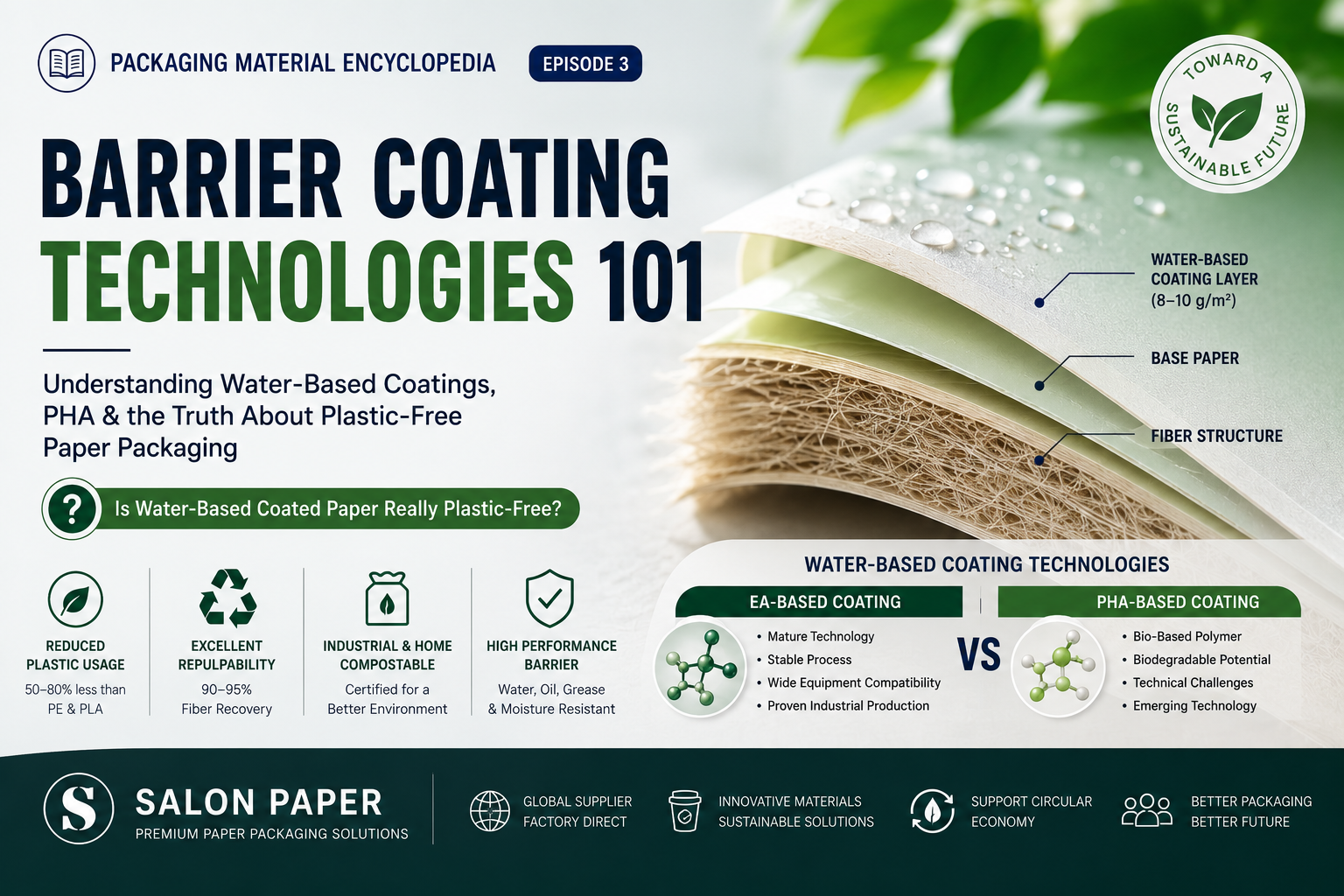
A medida que los gobiernos de todo el mundo introducen regulaciones más estrictas sobre los plásticos de un solo uso, las tecnologías de recubrimiento de barrera se han convertido en una de las innovaciones de más rápido crecimiento en el empaque de papel.
Today, terms such as Plastic-Free, Water-Based Coating, PHA Coating, Compostable, and Repulpable are widely used throughout the industry.
Sin embargo, estos términos a menudo se malinterpretan e incluso a veces se confunden entre sí.
Una de las preguntas más comunes que escuchamos es:
¿Es el PHA lo mismo que un recubrimiento de base acuosa?
The answer is No.
Comprender esta distinción es esencial para los compradores de empaques, convertidores y propietarios de marcas que evalúan soluciones de empaque sostenibles.
Antes de analizar materiales individuales, es importante comprender el concepto más amplio.
A Barrier Coating is a functional layer applied to paperboard to improve resistance against:
Sin un recubrimiento de barrera, el papel por sí solo no puede contener de forma segura muchos productos alimenticios y de bebidas.
Hoy en día, las tecnologías de recubrimiento de barrera más comunes incluyen:
This means that Water-Based Coating is a technology platform—not a single material.
Este es quizás el mayor concepto erróneo en el mercado actual de empaques sostenibles.
El PHA en sí mismo no es un recubrimiento de base acuosa.
PHA is a bio-based polymer.
It can be formulated into a water-based dispersion and then applied as part of a water-based coating system.
En otras palabras:
Barrier Coating
�?
├── PE
├── PLA
└── Water-Based Coating
     �?
     ├── Acrylic
     ├── EAA
     ├── PVOH
     ├── Polyolefin Dispersion
     └── PHA Dispersion
Therefore, PHA is one possible raw material used within certain water-based coating systems—it is not synonymous with water-based coating itself.
Esta distinción es particularmente importante al hablar de afirmaciones ambientales.
Another common misunderstanding concerns the term Plastic-Free.
Si un papel con recubrimiento de base acuosa puede describirse legalmente como sin plástico depende de las regulaciones aplicables.
According to the European Union's Single-Use Plastics Directive (SUPD), materials produced through artificial polymerization—including acrylics, EAA, and many synthetic dispersions—may still fall within the definition of plastic.
Therefore, many commercially available water-based coated papers cannot automatically be described as plastic-free, even though they contain significantly less polymer than conventional PE-coated paper.
For this reason, brands should be cautious when making “plastic-free” marketing claims.
Although many water-based coatings still contain synthetic polymers, they offer several significant environmental advantages.
A conventional PE coating often requires around 18–25 g/m² of polymer.
Many water-based coating systems achieve comparable barrier performance with only:
8–10 g/m²
This means:
Less coating means lower material consumption and reduced carbon footprint.
One of the greatest strengths of water-based coating technology is paper recycling.
Many products achieve:
90–95% Repulpability
During recycling, the coating disperses more easily than traditional laminated films, allowing valuable paper fibers to be recovered efficiently.
This greatly improves recycling performance.
Some advanced coating systems have successfully obtained both:
These certifications require testing for:
Unlike conventional plastics that simply fragment into microplastics, certified biodegradable coatings are designed to break down into natural substances under suitable composting conditions.
Today's water-based coating market is primarily driven by two technological approaches.
Currently the most mature commercial solution.
Advantages include:
For most commercial paper cups and food packaging today, EA-based coatings remain the dominant choice.
PHA represents one of the industry's most promising long-term technologies.
Its advantages include:
However, commercialization remains challenging.
Major technical barriers include:
As a result, PHA is still considered an emerging technology rather than a fully mature commercial solution.
| Feature | EA-Based Coating | |
|---|---|---|
| Maturity | Highly mature | |
| Supply Chain | Stable & reliable | |
| Coating Process | Standard equipment | |
| Barrier Performance | Excellent | |
| Biodegradability | Limited | |
| Cost | Competitive |
The future of sustainable packaging is unlikely to be defined by a single material.
Instead, successful solutions will combine:
Rather than asking whether one material is “better,” packaging buyers should evaluate which coating technology best fits their products, production processes, and sustainability goals.
At Salon Paper, we believe sustainable packaging is not about following trends or relying on marketing buzzwords.
It is about understanding the science behind materials and selecting solutions that deliver the right balance of performance, recyclability, and environmental responsibility.
As barrier coating technologies continue to evolve, we remain committed to helping our customers make informed material choices for the next generation of paper packaging.
No. PHA is a bio-based polymer that can be used as one component in certain water-based coating systems.
Not necessarily. It depends on the coating chemistry and the applicable regulatory definition of plastic. According to the EU's SUPD, many water-based coatings may still contain materials classified as plastic.
Because they generally use much less coating material (50–60% less than PE), offer excellent repulpability (90–95%), and some formulations can achieve industrial or home compostability certifications.
EA-based water-based coatings are currently the most commercially mature. PHA-based systems have significant long-term potential but still face technical challenges before widespread commercialization.
Looking for expert guidance on barrier coating materials for your paper packaging?
Whether you need PE-coated paperboard, water-based coated solutions, or want to explore PHA-based options for future projects, Salon Paper is here to help.
📩 Contact us today to discuss your project.
Ningbo Salon Paper Product Co., Ltd.
📧 george@salonpaper.com | 🌐 www.salonpaper.com
A Knowledge Series by Salon Paper - Continue learning with the full series: